
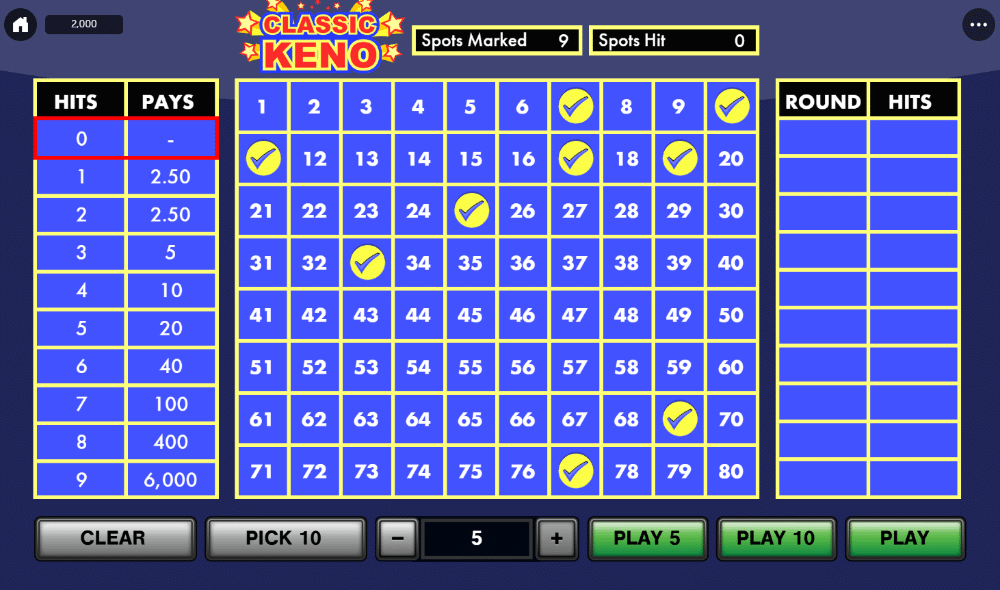
Keno payout structures determine prize amounts based on spots selected and numbers matched, fundamentally shaping game economics. Understanding payout mathematics reveals why certain bets offer better value than others. https://crypto.games/keno/ethereum publish transparent payout tables. Comprehensive payout knowledge enables informed strategic decisions.
Basic payout mechanics
Keno prizes scale based on two primary factors – the total spots selected and the number of matched drawn numbers. Higher spot counts require more matches for minimum payouts but offer substantially larger maximum multipliers. Lower spot selections begin paying from fewer matches, but feature reduced top-end potential. Payout tables display complete multiplier schedules showing exact returns for every possible match combination. House edge remains consistent across different selection strategies through mathematically balanced payout structures.
Spot count payout variations.
One-spot tickets offer the simplest structure, paying a fixed amount for a single match. Two-spot selections might pay two-to-one for both matches. Three spots typically pay three-to-one for three games. Four through six spot tickets feature graduated payout tiers with small prizes for partial matches and larger returns for complete hits. Eight-spot selections provide middle-ground variance with reasonable hit probabilities and substantial maximum payouts. Ten-spot tickets offer massive multipliers like ten thousand times wager for perfect matches occurring extremely rarely.
Mathematical house edge calculation
House edge represents the percentage of all wagers operators retain long-term. Calculating edge requires comparing actual payout multipliers against true mathematical odds:
- Edge determination formula – Subtract the total expected return percentage from one hundred per cent, revealing the operator advantage.
- Expected value computation – Multiply each outcome probability by the corresponding payout, then sum all products.
- RTP percentage – Published return-to-player statistics indicate the portion of wagers returned over infinite trials.
- Platform comparison – House edges typically range from five to fifteen per cent across different Ethereum keno platforms
Lower edges favour players through better expected returns, though all remain negative expectation games.
Progressive jackpot allocations
Some platforms dedicate portions of each wager to accumulating jackpot pools. Typical allocation might reserve five per cent of bets for progressive prizes. Jackpot contributions reduce standard payout percentages slightly but create potential for enormous wins. Progressive pools grow across multiple games until someone achieves a perfect maximum match. Accumulated jackpots reset after wins, then begin building again. Players must evaluate whether jackpot potential justifies accepting marginally reduced base game returns.
Minimum match requirements
Most keno games require minimum match thresholds before awarding any prizes. Ten-spot selections typically need at least five matches for a minimum payout. Eight-spot tickets might pay starting from four games. Lower spot counts often pay from two or three games. Understanding minimum thresholds prevents disappointment from near-misses falling below payout requirements. Strategic players consider minimum match probabilities when selecting spot counts.
Return to player percentages
Published RTP statistics reveal expected long-term returns to players. Ninety per cent RTP means players receive ninety cents back per dollar wagered over infinite trials. The remaining ten per cent represents the house edge. Platform RTP varies from eighty-five to ninety-five per cent, typically. Higher RTP platforms provide better mathematical value, though all eventually lose money. Comparing published RTP helps identify the most player-friendly options.
Complete payout mathematics reveals true game economics beyond marketing claims. Strategic players analyse payout tables, comparing value across different platforms and spot selections. Mathematical literacy enables informed decisions, maximising entertainment value per dollar wagered despite inherent negative expectation.
